
A Season for Strategic Moves
"More and more, so it seems to me, light is the beautifier of the building." ~ Frank Lloyd Wright
Spring is approaching. It’s that time of year for movement and new beginnings. It’s an opportune moment to harmonize with that energy.
My wife and I are preparing to leave the home we’ve been living in for over six years. We’re looking for a better fit for our work, our rhythms, and the life we’re looking to build together. In some ways, this house has not merely been a home, but a proving ground. Owning a home is like holding up a mirror to yourself. It reveals your habits and your limits. It tests you. There’s always something that needs tending to—repairs, maintenance, and you learn much in the process. One thing we’ve also learned is who we are.
As workaholics, we’ve picked quite the enabler of a home. There was always another project, repair, or improvement to gobble up our free time. Over time, we became weary of tending to busyness over business. My wife has hobbies of her own she needs space for. I need space that yields me the room for growth for my most significant pivot yet. It’s time for a home that’s more balanced, needs less maintanence, and feels less isolated and more connected to those around us.
Earlier this year I took one of the deepest dives into the reflecting pool yet. I had walked away from a lucrative mechanical design career last year. Since then, I’ve spent months experimenting, working with new materials, processes, and product ideas.
That period was one of self-inflicted frustation. I kept looking for the right niche to break into. I had introduced new products—some I still sell, others felt-off brand from the beginning. I was more focused on anticipating what would resonate with customers, rather than focusing on what already has.
Late last year, I was still looking outward for direction. Earlier this year, I turned inward. I stopped asking, “What can I make that people will buy?” and started asking, “What would I make regardless?” Looking back through my catalog, a pattern emerged. The products that sold weren’t contrived ones, but products that were designed straight from instinct. Those products were well-balanced, structured, and true to who I am.
It was an uncomfortable realization at first, only having an engineering background and no formal artistic training. Trusting my instincts seemed counterproductive. As I began articulating what I was naturally drawn to—structured light, shadow, depth, shelter, letting materials speak for themselves—I started noticing that these instincts followed a coherent design language. They echoed ideas I later found in the work and philosophies of architects and designers I respect.
It’s unfortunate that what I was naturally drawn to was moved to the back burner in pursuit of short-term income. It wasn’t all wasted though. During this time, I’ve become very familiar with new tools, ideas, methods, materials, and experiences that will aid future designs.
There was always a reason stained glass spoke to me. Some of my earliest memories of light given structure and form were in church—where ordinary sunlight passed through stained glass and emerged deliberate, shaped, and alive with color. Giving structure to light, harnessing it creatively, and constructively was always appealing.
That structure doesn’t belong to stained glass alone. Light can be filtered, diffused, directed, softened. A light screen can change how daylight enters a room. A strategically placed lamp can change the mood of a space, highlighting certain shapes and features with purpose while softening others.
This is a lane that keeps calling to me. It’s broader than stained glass, but within the same family of design intention. I’ve often found myself frustrated with the intensity of modern lighting—the overuse of bright LEDs, cool temperature lighting coupled with bright surfaces for a harsh, white-out effect, fixtures that are more utilitarian than complimentary to a space. We need respites from the harshness of nature without introducing artificial harshness indoors.
This is my lane and I’m staying in it for the long haul. My goal is to create lighting, light screens, and shades that helps define the spaces they occupy—where light and shadow are the notes and rests in a harmonious composition. Shadow suggests depth. Depth helps define the features of a space, giving them presence. Stained glass will still be a component of this larger design language mirroring those same balanced, compositional contrasts.
When it comes to style, I use modern tools and materials, but they’re built on traditional foundations. The goal isn’t nostalgia or trend—it’s permanence. Design that feels grounded, intentional, and at home in its surroundings. There’s structure beneath the surface—enough to suggest complexity, but not so much that it overwhelms.
Ultimately, I’d like to move from designing products that shape environments to shaping entire environments themselves—making our homes feel more inviting and calm, like a shady grove on a hot summer day. Many of us live in spaces that constantly overwhelm the senses. I’m more interested in design that attunes our senses to a quieter beauty.
That’s the direction I’m committing the shop to. The next several months will involve a good deal of R&D before the move and after as I refine the tools, materials, and designs that supports this shift. The shop will likely be quieter for a time, but I’ll still have some legacy patterns, items, and customer support as always. I’m not stepping away. I’m building toward something more cohesive and aligned with the work I always wanted to pursue.
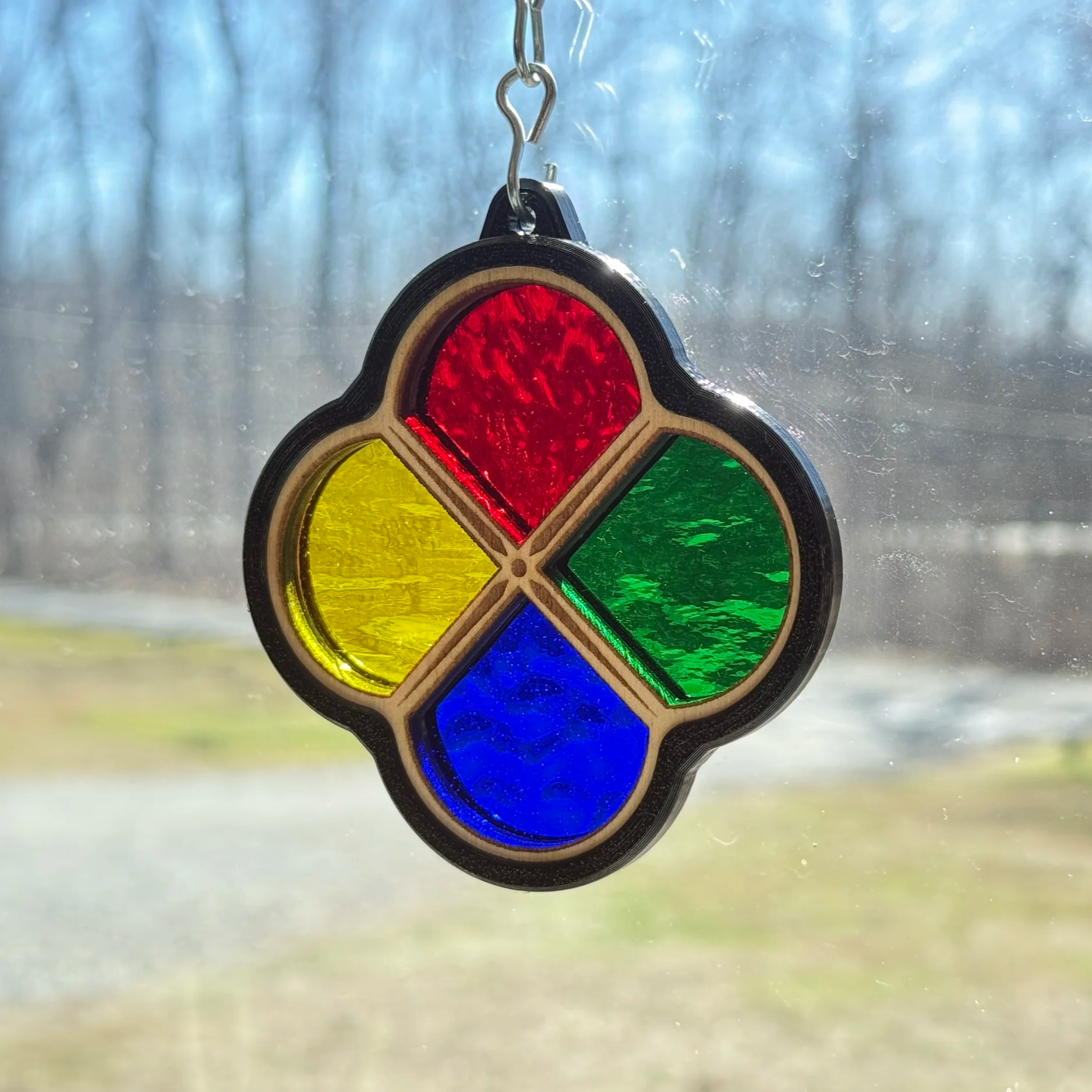
First experiment of the year. This stained glass quatrefoil suncatcher is the 2nd gen. version of experimenting with came of the non-soldered variety. This is 3D printed, engineered came with wood veneer that creates pockets of light highlighting each hand-cut glass piece—giving them a thicker appearance.
Subscribe on Substack to receive new updates.