
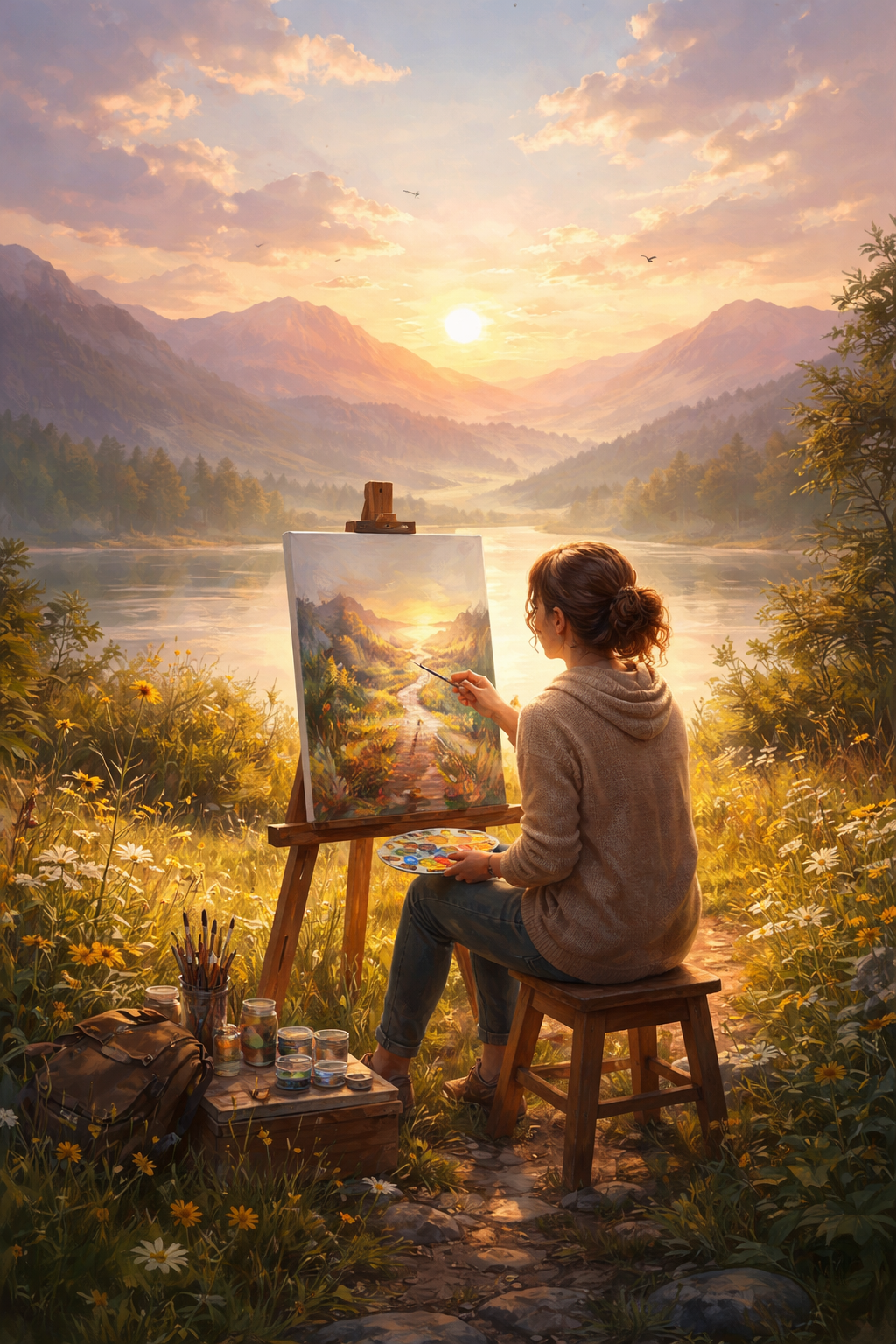
What’s the Point of Suffering for Your Art?
“The more the artist is suffering, the less creative he is going to be. It’s less likely that he is going to enjoy his work and less likely that he will be able to do really good work.” ~ David Lynch
Life’s struggles can reveal what people are made of as a blacksmith hammers out impurities leaving only steel. But what if we’re still in the throes of these struggles—reverberating from impacts we’ve experienced years ago? How does that shape how we work and what we produce from that work? These tests of our mettle will harden us enough to keep from breaking. But the next step of fine-tuning and sharpening ourselves is how we really form our edge.
Many of us in the art world find ourselves stuck in a hardened phase—reliable, capable, but blunt. The echoes of the past bring repetitive results: we suffer, we make something, we hope for catharsis, and then do it all over again. Honing ourselves to a fine point is what gives that hardness direction.
Clinging to the hardened phase of this journey feels safe. Events have shaped us into who we are today—functional, productive, our output is valuable, but our true potential is still unrealized. This is the phase of perfectionism, not mastery.
How do I know if I’m stuck in this phase? There are a few signs:
1. You’re suffering for your art.
The struggle is baked into your identity and the process of creation. Is it a labor of love or a form of martyrdom?
2. Your work is primarily logic-based.
It’s safe, it’s competent, but not particularly inspiring. It could be lacking a personal stamp.
3. Your art could be provocative in a self-sabotaging way.
It represents mourning, lashing out, it’s defensive, and/or meant for provocation. It drives people away as much as it expresses because it’s purely based on pain rather than intention.
Personally, I’ve spent most of my time in signs one and two. I’ve thrown myself into the work so much that it caused burnout and a loss of enjoyment. I’ve often defaulted to the logical approach to avoid creating work reminiscent of sign number three. I don’t think pain and suffering are subjects to be avoided, rather they should be held within a broader, constructive context.
We’ve all heard many of these success stories—someone from humble beginnings with a rough childhood goes on to become a CEO of a Fortune 500 company or wins the championship. Sadly, many of these goals were reached while these people were still in the hardened phase. That’s accomplishment without fulfillment—a life envied on the outside, yet incomplete on the inside.
A blunt instrument can’t make a point. The next step is where we create our edge.
The grindstone may refine us further, but the whetstone is where gentle, intentional strokes provide the finishing touch. Hardening has allowed us to survive without shattering. Sharpening is a delicate process—one in which we begin to intentionally shape ourselves. Until now, life has provided most of the shaping. Now we decide what remains and what gets pared down.
This refinement with purpose is not just how we gain more agency, but where the healing really starts. Our inward transformations will reflect on our outward actions. Our creations will no longer exist as attempts at catharsis or simply hiding ourselves behind competence, we will finally get to make honest expressions based on our choices. Healing is not how you lose your edge—it’s how you develop it. It’s how the impacted can learn to be impactful. We labor to enjoy life and we create to share that joy with others.
Subscribe on Substack to receive new updates.