

It Just Might Be Stupid Enough to Work
Because a rudimentary solution is better than a frustrating problem.
“The handyman’s secret weapon — duct tape.”
— Red Green
We can all summon creativity from the unlikeliest places. Maybe you’ve used a broken Hot Wheels car as a doorstop. Perhaps you’ve MacGyvered your way out of a jam using a plastic bottle as a funnel when you didn’t have the real thing handy. Our minds make these interesting connections from an early age, finding unintended uses for everyday objects.
I remember, as a young boy, using a Fisher Price Activity Center meant for infants as the control module for a time machine. Over time, adulthood gives us a sense of helplessness that a stubborn young child would deny. “I’m a big kid now! I can do anything!” There was an undying creativity coupled with a naïve boldness that made interesting improvisations possible. Like when the five-year-old version of me stood up to much older neighborhood bullies with a plastic sword and shield. It didn’t occur to me that they could throw me across the lawn. I was a “warrior” after all. My father came out of the house and told them to beat it, but I can still remember the puzzled look on their faces when I went at ’em. Failure doesn’t even occur to a young mind that much.
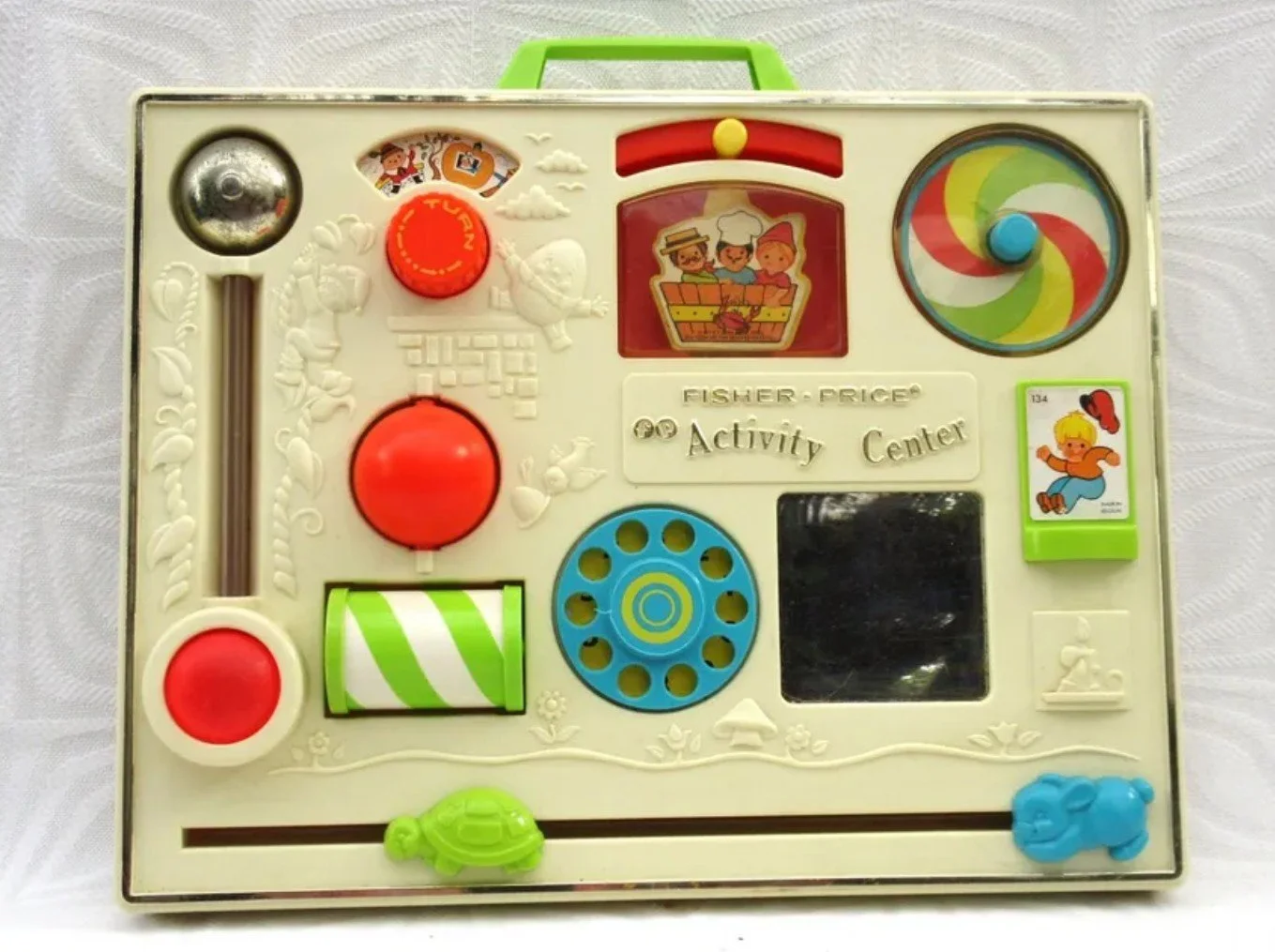
Well, it looks like a time machine control module, doesn’t it?
Well, back to adulthood. At this point in our lives, we’ve developed a multitude of constraints on our perspective. Everything doesn’t seem so possible now. We’ve encountered plenty of limitations that have discouraged us somewhat. A deeper understanding of physics comes to mind. It’s easy to slide into a toolbox fallacy. “If I had this object, only then I could perform this task.” Sometimes you really do need that object. Other times, you really don’t. Sometimes, you just need to be creative. What do you do when the object you need doesn’t even exist?
Hell, depending on the material, a screwdriver can do a fine job at scraping and chiseling. Now, we don’t want to go too far out on a limb here. We don’t want to use a screwdriver as a substitute for a large pry bar. But certain objects can have multiple uses outside of their original intent, and they may even be well-suited for them. Sure, duct tape, zip ties, and chewing gum are not the most glamorous utilitarian items, and nothing says “hack” like a fender being held together by all three, but we shouldn’t be afraid to improvise when necessary. Living with a frustrating problem can be worse than accepting an ugly fix. Certainly, if we have the means for a better solution, go for it. But if you need to make an ugly adjustment just to get by for the time being, it is well worth it.
I see three basic categories for these household solutions: temporary rigging, a fine substitution, and a permanent solution.
Temporary Rigging – Buying time.
I’ve already used the fender example, but I’d like to share one of my own. It’s certainly more of a simple, subtle fix than holding together a broken fender. My overhead garage door has rubber weatherstripping around it, but sometimes the door and its framing are not perfectly square to one another. Gaps can occur in the corners. I had one such gap in one bottom corner.
Living in a rural area means more bugs. They’re everywhere. Only winter brings a respite from them. Anyway, I was tired of getting mud wasps in the garage. They aren’t the worst wasps to deal with, but I don’t need that kind of frustration in my life. For years, I couldn’t think of what to do. I couldn’t caulk it. It’s an area where moving parts are in play.
I’m not a weatherstripping expert. I wasn’t sure if there were any tricks or products that would help, or if I needed newer, better weatherstripping. It wasn’t like there was anything wrong with it. One day, it dawned on me. What if I wedged something between the wall and the guide rail for the door? It would close off the gap.
I had some air conditioner foam laying around. I use it to temporarily seal all kinds of gaps, mostly to keep bugs out. Can’t caulk something yet because of the weather? Stuff some of this crap in there and then pull it out when you’re ready. Have a window screen that suffers from a similar squareness issue? Stuff some air conditioning foam in the gap.
I wedged a big rectangular block of it between the garage wall and the guide rail. I pushed it up against where the door would be in the closed position, and I could no longer see any daylight. Gap closed. The highway system for pesky mud wasps has been shut down. Would that foam last forever? No, but it should last many years.
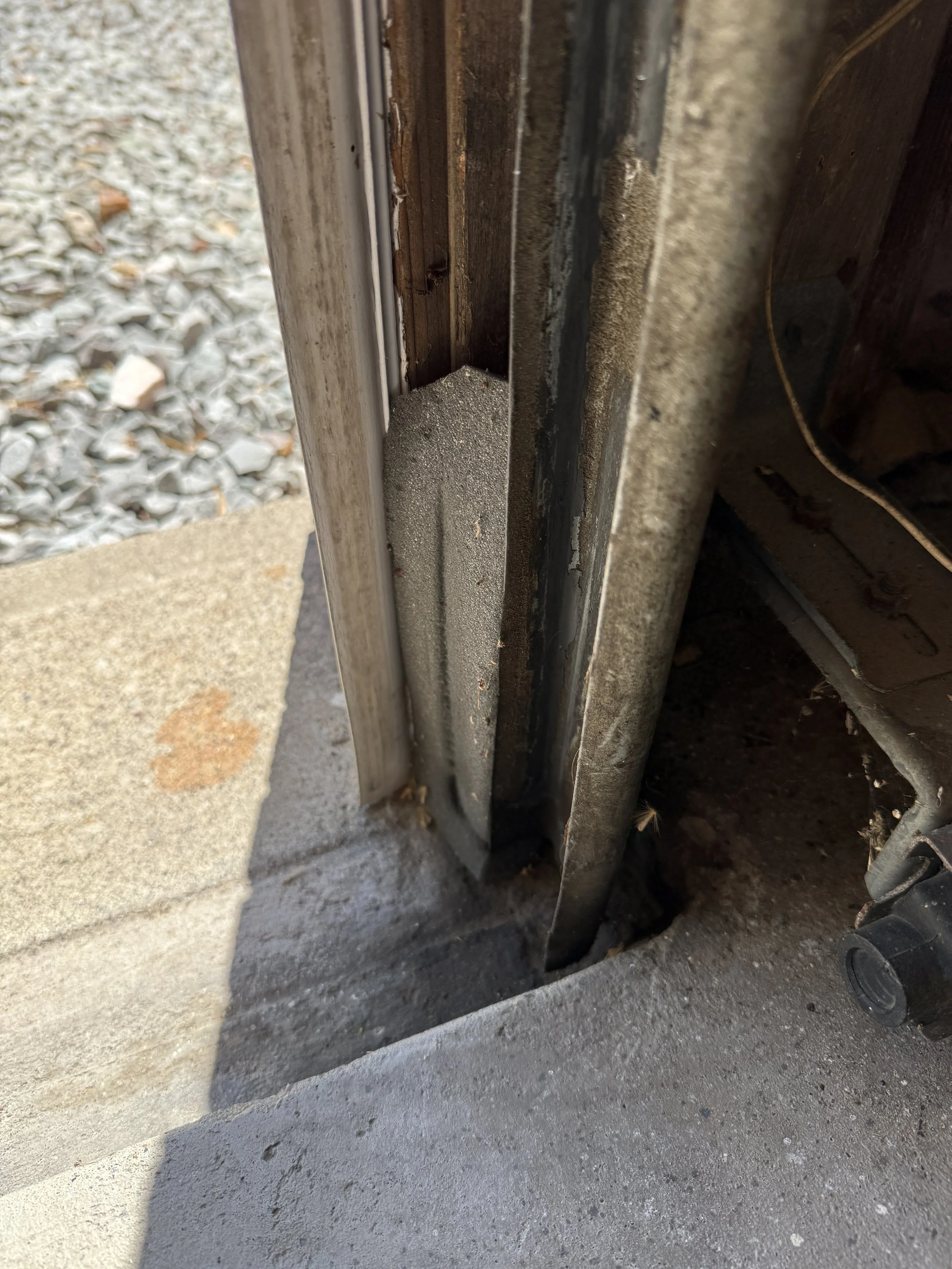
Air conditioner foam with a creepy spider above it.
A Fine Substitution – When the wrong object works just fine.
My wife has two laptops on her desk. Her personal laptop sits atop a nice stand with plenty of adjustability, so she can switch between standing and sitting at her adjustable desk. The work laptop has a cheap stand with only so much height adjustment. Since her keyboard is hooked up to the work laptop, she doesn’t need the same amount of adjustment her personal laptop stand has, but it still needs to sit higher in order to work with a dual monitor setup.
We couldn’t figure out what to use, and we didn’t want to buy another laptop stand. Good ones can cost up to $100. I could go out into the garage and cut up some lumber if I wanted the Temporary Rigging approach, but no thanks. I had a small black plastic crate that I didn’t want anymore. For kicks, I sat her cheap laptop stand on top, and sure enough, it was a good pairing. I tried using wire ties to connect the two disparate objects, and it was surprisingly stable.
I thought this would be super temporary. After all, it only barely makes the Fine Substitution category, but it has been five months and she hasn’t had any issues. No tip-overs, no sliding around, just a fairly ugly but stable setup. Crates are rather versatile. Larger milk crates have traditionally been used for step ladders, organization, impromptu shelving, even basketball hoops. This setup isn’t nearly as much of an eyesore as screwing some 2x4 scraps together. It can be as temporary as we want it to be. We’ll see if we end up getting a proper stand in the future, but for now, a successful setup is good enough.

Who needs a $100 adjustable laptop stand when you have a cheap one and a crate?
A Permanent Solution – What I need doesn’t exist, but here’s what works.
Our property has a spring-fed swamp. While it is a wonderful source of a wide variety of flora and fauna, including several species of frogs, toads, snakes, the occasional painted turtle, hummingbirds, and wildflowers teeming with butterflies such as the beautiful Eastern Tiger Swallowtail, it is also the natural home of the drain fly. I would see them outside sitting on our windows, doors, and other surfaces. Some would get in through open doors, and I would dread having an infestation in the making.
At one point, we had a few floating around in the basement regularly until I removed an old dehumidifier that was left with the house. It had no hookup to drain directly into a hose. Instead, the condensation would drip into a reservoir first, one that would often clog and fill up with a dusty film. The dryer is right there near the drain, so lint dust was the culprit in this case. The hose was connected to a reservoir discharge point that would dump into the floor drain. It would often get clogged. It was just a mess. After a while, we had enough and kicked that filthy old machine to the curb.
The next dehumidifier had a drip pan where you could bypass the reservoir with a hose, plus an air filter to keep dust from getting sucked into the unit. It was a far superior design. The hose did not clog up, and the reservoir was never used. I then used an enzyme cleaner to treat every drain in the basement as a precaution. We haven’t seen drain flies since, but I would make damn sure I did everything to protect the drains just in case some drifted back into the house.
The basement has an old bell trap floor drain. We’ve never had the cover on it, so naturally, a half-spherical mesh drain screen covered the area quite nicely. I added some stick-on weatherstripping at the bottom to smoosh the cover on and to account for irregularities in the pitted, rusty portions of the drain. It fit like a glove.
Except the hose still needed to drain into the opening somehow.
If you’ve ever seen one of these drains, water just collects at the bottom until it reaches the top of the opening. The water just sits in there. I didn’t want that. So, I rested the tip of the hose on top of the screen. If it sat just right, the hose would drip through the mesh and into the opening. But move it ever so slightly, and the dripping would slide down the mesh and collect around the sides. Ugh! It didn’t take much to accidentally kick the hose or get it caught up in the vacuum cleaner cord.
After fussing around with it for a year or so, the solution finally presented itself. The mesh screen was great. It did the job. It kept detritus and any drain fly that wandered into the house from getting in there, but keeping the hose in the right place was frustrating. A little modification was in store.
Since you need a place for the water to collect and drip through, why not just create a deformed pocket in the middle? I did just that. I pushed in the top, center portion of the half-sphere to create a dip. I did not puncture anything. I just created a place for water to pool for a few seconds before dripping through the mesh. I rested the tip of the hose on top of that area.
It worked beautifully. I no longer have this mess of water collecting around the sides, pooling up, and pissing me off. The screen can also be easily removed for cleaning/replacing. In the past, I tried using the same screen mesh and added a hole in the middle for the hose, but I often wondered if the hole was too big or if the screen was still effective.
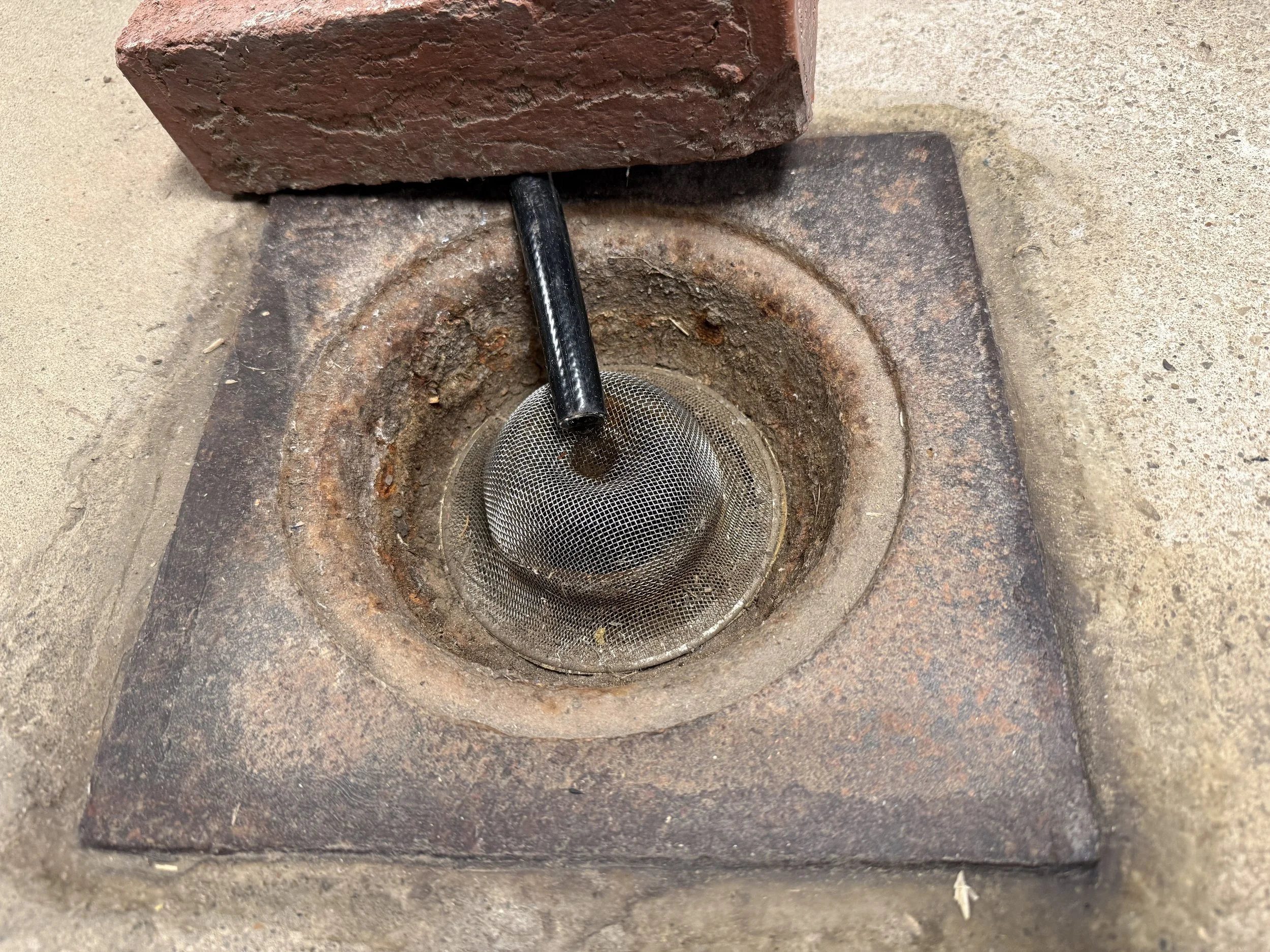
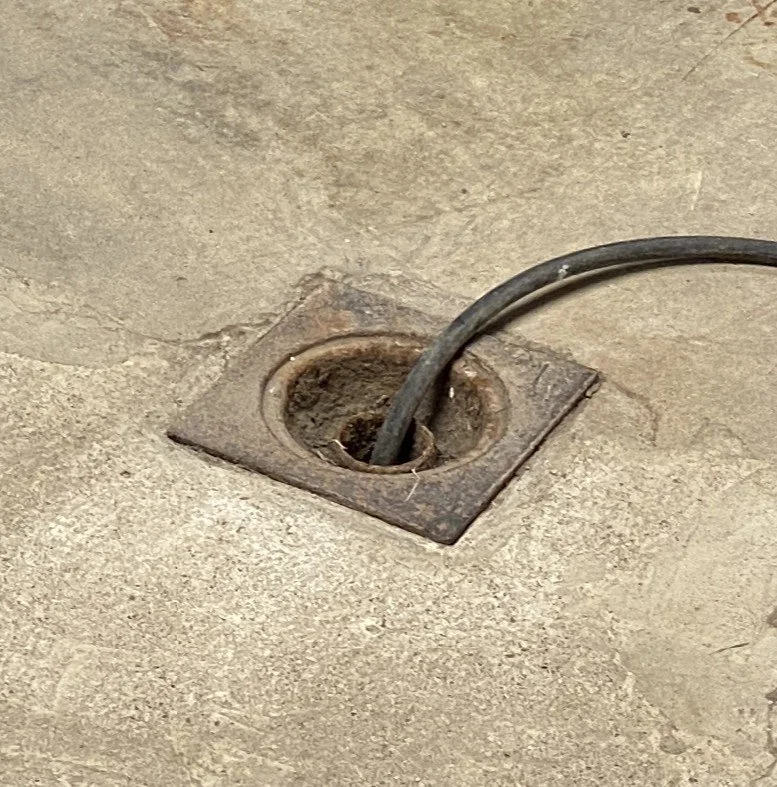
Screened (left), unscreened (right).
We don’t always need the perfect product to make our lives easier. Sometimes, the solutions are not immediately evident. Observation is the first step. Where is the water going? Where is the gap? What keeps moving? What keeps clogging? What keeps attracting bugs, collecting dust, sliding out of place, or pissing us off every time we walk past it?
I’m not saying anyone should rig up some fantastical, potentially dangerous structure instead of building something properly. If you don’t know how to do something safely in the first place, your solution is probably doomed from the start and might get someone hurt. There’s a difference between a clever workaround and a code violation in the making.
But there are so many little stupid annoyances around a house that can be dealt with if we don’t let the perfect be the enemy of the good. Not every problem needs a renovation. Some need a proper repair. Some need a professional. But some just need a scrap of foam, a plastic crate, a bent screen, or whatever strange little answer presents itself after enough frustration.
A rudimentary solution is not always beautiful or permanent. It may not be the sort of thing you advertise to the entire world, but still, when the thing stops leaking, wobbling, clogging, buzzing, or letting mud wasps into the garage, there is a small victory in that.
And sometimes, that is enough.

AI-generated image of a “Temporary Rigging” setup. Warning: no actual fenders were harmed in the making of this post.
Subscribe on Substack to receive new updates.