
Considerations of Quality
“Give them quality. That’s the best kind of advertising.” ~ Milton Hershey
As a consumer, a product-maker, and as someone with an engineering background, quality has been a large factor in my decision-making. From contemplating which product to buy and how to design the best products, in my opinion, quality is one of the most important standards equivalent to function. If a product fails, it can’t function. If you build a garage and it doesn’t hold-up, it fails to be a garage. This is the approach I’ve taken within my many years as a product designer. But there are other considerations that lead to the creation of a quality-oriented process for achieving these design goals. I may not be familiar with industrial standards such as ISO 9001 and exactly what they entail, but I’ll discuss some perspectives, experiences, approaches, and observations within this post.
From a consumer perspective:
I look for items that are built to last. But why are so many items not built to last these days? You can expect packaging to be something you’d use once and throw away, but not household items. My parents would get bed sheets from Sears for decent prices in the 70s and 80s that would last 40 years or more, yet you can’t get a sheet set for $100 that would last you more than a couple of years if you’re lucky. Sometimes expensive items can be cheap. Sometimes expensive items can last you a long time. In 2005, I had just moved out of my parents’ house. I needed some new towels. I bought some at Bed, Bath, and Beyond for around $20 a piece. It was steep, but I wanted quality. They were made in the USA too. They turned out to be an excellent investment. I still have these towels to this day. Some are a little more on the raggedy side, but are still thick and absorbent. I checked back a few years after purchasing these towels and sadly, they were no longer made in the USA. It’s also a strange notion that you get more finger-wagging to turn the thermostat down or to keep the air conditioning off, yet much of our household goods are throw-away garbage. So, if your toaster only lasts 2 years as opposed to 2 decades, what kind of natural resources are being wasted and what’s the pollution output of producing all of these low-quality products over and over again, not to mention shipping them half-way across the world? I’d personally much rather live in a home filled with non-trendy items of quality that will last than brand new junk. Sure, my avocado green stove could be from the 70s but hey it works better than that electric stove from 2 years ago! But, that’s just my preference as a consumer.
From a product-design perspective:
What determines whether a product is built to last? It comes down to cost of materials, cost of manufacturing, costs of design, a reliable & consistent manufacturing process, strict quality control, customer demand, and a culture of quality. If you’re equipped to make a quality product that lasts a lifetime, but your customers are not looking for that, they want something cheap with quick lead times, you have to build to the demands of the customer. If you can provide the highest quality possible despite those limitations, then you have found a nice pocket to work in. You can make a suncatcher out of stained glass which will break if it falls to the floor or you can make one out of concrete. Even though glass is brittle, it’s a much more interesting material for the purpose of suncatchers than concrete. Fragility isn’t always the measure of quality. Sometimes, fragility is what is desired. You can make shoes out of concrete too and they will last forever, but they wouldn’t be practical in the least. The best balance between quality and function will yield the most superior product. They are the twin aspects of success in design. A concrete suncatcher is high on quality, but inferior on function. A plastic suncatcher however, will look beautiful in a window and would better withstand a fall, but to many in the market, the fact that plastic is used as the primary material could invoke a certain sense of cheapness. Even though it’s made from a high quality material in terms of rigidity and is high on function, it still may not win over everyone.
It can also be difficult when the culture of the market and the culture of the company are not as quality-oriented as you are as a designer. You see a lot of stuff fall through the cracks and you wonder why you even bother. The stars of design align in scenarios in which you can deliver a quality design/product quickly and inexpensively, but not all things should be rushed. You can’t deliver a quality whiskey after 2 weeks of barrel maturation. Hence, the more aged and refined whiskeys are more expensive and much more pleasing to imbibe. But if the company and the customer are dead set on creating a whiskey that’s only aged for a year, you may be turned off by this notion. It wouldn’t be a great fit for an aged whiskey aficionado to be a part of the whiskey-making process at such a company. In my experiences as both consumer and producer, there are all kinds of budgets, tastes, and demands. Some are perfectly happy with getting a new toaster every 2 years. In fact, they prefer it. The same thing with furniture: many like to replace their furniture every 5 years because they want a refresh every so often. Others are willing to buy furniture that would last them 20 years and they don’t care if their homes have the same look for that long. When the product designer, manufacturer, and the markets have aligned values, it’s a much more harmonious scenario for all involved.
There are also instances when values aren’t aligned between departments within a company or there isn’t a uniform, written standard that everyone can use as a guideline. This can also cause quality issues. For instance, when I make production drawings, I am fully aware that the drawings are only as good as you can effectively communicate your vision. If you want a welder to weld something a certain way, you must specify that. If you want an assembler to route a wire through a certain path, you must indicate that. I’ve seen many scenarios in which there are welds in areas that interferes with hardware or another object because it wasn’t specified on the drawing to leave those areas free of weld. Not only does a product designer have to design a functional and quality product, but they must communicate to everyone within the manufacturing process via a drawing or other means on how to make that exact product to your specifications. Sometimes, it doesn’t matter. Despite your best intentions, a manufacturer could ignore aspects of your drawings for whatever reason and then a quality inspector could overlook something too and there goes the inferior product straight to the consumer. You could have inadequately trained staff down the line and it becomes the weakest link in the chain. It’s also possible that you can produce a great product but everything seems to go wrong within the shipping & handling process. Great product as well as great packaging is also necessary. You don’t want to go through all of that trouble creating this wonderful item only to have it shipped in some flimsy packaging that renders all of that effort null and void.
In larger companies this process becomes increasingly sophisticated. Sometimes you need to design a well-oiled machine (a competent manufacturing team/process) to produce a well-oiled machine (a great product). Sometimes a sales team could throw wrenches within that process in very counterproductive ways. The sales commission system can be a conflict of interest. The salesperson could promise the customer all of these extras that win the sale, but effectively leaves the rest of the company at a disadvantage as they scramble to meet all that was promised causing potential gaps in quality. Sometimes certain sales are more trouble than they’re worth whereby lofty promises could lead to unsatisfied customers overall. They get their commissions, while everyone else is left holding the bag. Again, all values and goals must be aligned from the sales team, to the designers, to the manufacturers, down to the demands of customers for the most harmonious collaboration. You have to pick your battles. If you say “no” to everyone, you’re getting no sales. If you say “yes” to everyone, you could be overextending, creating too much risk within the process, exceeding lead times and/or potentially sacrificing quality which could ultimately lead to no sales.
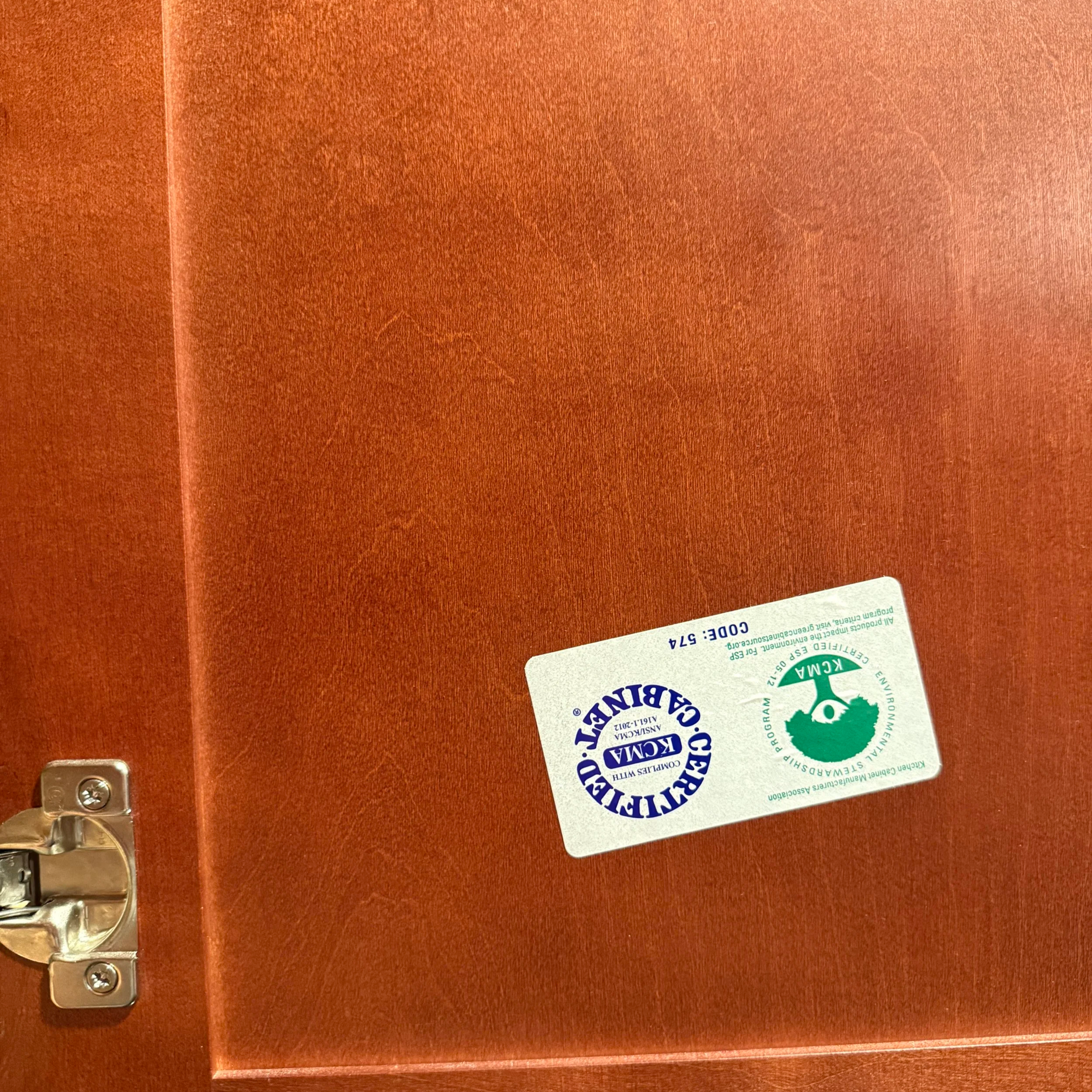
If you ask anyone, there definitely seems to be a diminishing level of quality these days. The above picture is one such example: it’s of a cabinet door in my kitchen. The sticker is placed quite haphazardly and upside down onto the back of the door. With little attention paid to these minor details, you can’t help but think what else could be wrong with these products. To me, as a designer, it’s not just important that the product is functional, but to demonstrate a presentation of competence at every step of the way gives people some assurance that all is well. There are several factors at play that have led to this decline in quality:
1. Shorter Design Cycles: the market is centered on retail windows. Get the products out fast or miss out. R&D times are shortened or nonexistent. If you spend too much time perfecting the product, you may end up behind the trends.
2. Efficiency Versus Durability: also ties into retail windows. Companies are looking to save money and time on every part of the process. If a product fails, they simply replace it which overall is much cheaper than taking the time to design a higher quality product.
3. Reprioritized Design Goals: opt for replaceability over serviceability. This ties into the first two factors. It’s quicker and cheaper to design parts that aren’t serviceable. There’s no need to make service manuals or to create the means for access to take things apart for replacement. No need to manufacture and store extra replacement parts equals less capacity and overhead.
4. Added Complexity: mostly mechanical devices such as washers, dryers, and automobiles are now filled with electronic devices galore: controls, indicators, digital gauges & displays, sensors, touchscreen interfaces, etc. which are generally not as reliable as simpler, mechanical-only machines.
5. Skin in the Game: when you have no incentive to work harder or to do a better job, it’s not difficult to see what direction human nature generally gravitates to. For instance, if you work for a large firm, you don’t always see yourself as an integral part of the organization. Your input is such a small portion of the overall output that there are so many other factors that can go into the resulting product or service. It’s easy for people to develop an attitude of “it’s not my company,” or “it’s somebody else’s job,” and “there are so many problems, nobody would notice this mistake.” You may never personally talk to customers. You may not even work in the same country that manufactures the product so there’s a complete disconnect. Also, it’s quite possible you don’t ever see the finished product that you’re working on. This isolation from it all can lead to a sense of meaninglessness. It’s another story entirely if you work for a small firm and you have more direct connection to the entire product-making process. You can see the satisfied faces of customers, you can hear their concerns, and you work closely with the manufacturing team. The feedback loop is immediate. You’re more involved. It’s exciting. It’s much more meaningful. You feel like you have a real stake in this company as you are attributed to being a part of its success. It’s even more meaningful if it’s your company! Your last name is on the logo. Your reputation is at stake!
6. Technological Developments in Design: this is both a net positive and negative. For example, instead of overbuilding a part, you can use design software to show exactly how thick you need to make a material to serve its design function. In the past, you’d just make it thicker, heavier to be on the safe side, but if the software can demonstrate at which point this product fails at which thickness and with which material, you can save money on time, materials, shipping costs/weights, etc. The good news is that you don’t have to overbuild something to yield a quality product. The bad news is that it can be tempting to really skirt the line between passing quality and failing quality due to this knowledge. Sometimes, a company can design a product knowing that it might fail within an acceptable range if it means ultimately saving more money by not making that material as solid as it should be to yield zero failures. They’ll just replace it quickly, the customer is still happy enough and the quality will never be all it could be.
7. Consumer Expectations Have Changed: “What do we want?” Cheap! “When do we want it?” Now!
The news isn’t all bleak here. Our internal combustion engines are far more reliable than they were say, 40 years ago. Most cars get up to 150,000 miles plus. Sure, your touch screen, personal computer, can-opener, seat warmer portions of the car probably won’t work by then, but hey the thing is still kicking! Quality control measures within many industries have also improved to provide stricter standards and thorough analytics, while automation has improved consistency, eliminating some of the propensity for human error with traditional approaches. It’s a mixed bag. I love driving more reliable cars even though my Sony PS5’s disc drive stopped working a month out of warranty. I’m also privileged to live in a time that has provided so many quick, inexpensive creature comforts. The downside is that for us who are old-fashioned, we’d like to see a return to quality, reliability, and durability. It makes us feel like we’re respected more. Being given too many junky options makes us feel like we’re not worth having nice things. Hey! I’ll pay some extra money and wait longer for a product that won’t let me down! Where’s the market for my needs? I don’t always want it cheap and/or now. I’m also not sure how sensible it is to keep wasting raw materials on throw-away products. It’s pretty… wasteful. We’re not powerless in this though. All of us have roles to play in our careers. We can find a team and a customer base that aligns with our values. We can find pain points in the market and cater to them with our own businesses. We have a lot of power as consumers, creators, and designers. We can change trends by changing our habits or we can think of ways of innovating: for example, the customers who want to change their furniture around every few years could get access to quality furniture, but also have the option to reupholster things at home in a way that’s almost as easy as changing “skins” on a program’s graphic user interface. Maybe that already exists. You never know. Creativity can conquer all!
Subscribe on Substack to receive new updates.